CAPC 2026 Pet Parasite Forecast Just Released: Expanding Vectors, Emerging Hotspots and a New Era of Year-Round Risk
PR Newswire
SALEM, Ore., March 23, 2026
New National Forecast Signals Expanding Vector-Borne Disease Risk for Dogs – with Implications for Human Health and a 94%+ Accurate Early Warning System
SALEM, Ore., March 23, 2026 /PRNewswire/ -- The Companion Animal Parasite Council (CAPC) – the leading authority on vector-borne diseases affecting pets and people – today released its 2026 Pet Parasite Forecast, projecting continued geographic expansion of Lyme disease, ehrlichiosis, anaplasmosis and heartworm risk across the United States – including growth in areas once considered low or moderate risk.
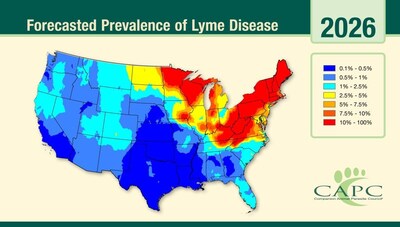
The CAPC annual forecasts are designed to predict what veterinarians and diagnostic laboratories will find when testing dogs for these diseases in 2026. Historically, CAPC's forecasts have achieved 94% accuracy when validated against reported nationwide diagnostic results throughout the year.
Built on more than a decade of disease surveillance and analysis of over 10 million veterinary diagnostic test results per disease each year, CAPC's precise forecasts serve as a national and county-level early warning system. They offer critical insight not only for veterinarians, but for broader public health as well.
"Vector-borne disease risk continues to expand – and not in straight lines," said Kathryn E. Reif, MSPH, PhD, Associate Professor in Parasitology at Auburn University, CAPC Board Member and lead author of the 2026 forecast. "Land use changes, pet travel, wildlife dynamics, and climate-driven warming and extreme weather are accelerating shifts in where and when these vectors spread. These 2026 forecasts are forward-looking tools, built to predict what clinics and labs will see this year. They help veterinarians strengthen year-round prevention efforts, tailor vaccination strategies based on local risk, and reinforce annual testing – keeping pets safe from these potentially fatal diseases."
Nowhere is this expansion more evident than in the continued spread of Lyme disease.
Lyme Disease: Expansion Beyond Historic Hotspots
Blacklegged ticks, the primary vectors of Lyme disease, continue to expand geographically. While the Upper Midwest and Northeast remain high-risk regions, the 2026 forecast projects notable expansion across Ohio, Kentucky, West Virginia, Tennessee, North Carolina, Indiana, Illinois and Michigan – with sustained risk spreading westward into the Northern Plains.
Areas where dogs face higher Lyme risk closely mirror where people contract Lyme disease – reinforcing the One Health connection between pets, people and the environment.
"Dogs are sentinels for human health," said Craig Prior, BVSc, CVJ, CAPC Board Member. "When we see rising Lyme, ehrlichiosis or anaplasmosis risk in dogs, it often reflects the same environmental pressures affecting people. Parasites are dynamic and ever-changing – and they're on the move, potentially to a backyard near you. If we don't know the risks in our own backyards, we can't properly protect pets or their families."
In areas where Lyme risk is rising, veterinarians should strengthen tick prevention and reassess vaccination strategies now – not after cases climb.
Heartworm: Persistent Risk and Northward Spread
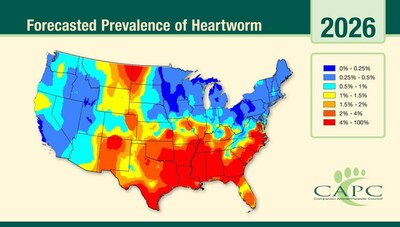
Heartworm disease, transmitted by mosquitoes, remains entrenched in the Southeastern United States, with continued spread northward along the Mississippi River corridor and up the Atlantic coast.
The forecast also highlights consistent pockets of elevated heartworm risk in parts of the Mountain West and Northern California – regions not traditionally considered endemic. Movement of infected dogs, expanding mosquito habitats, urban development, and inconsistent preventive use continue to drive transmission.
Ehrlichiosis and Anaplasmosis: Expanding Tick Ranges, Expanding Risk
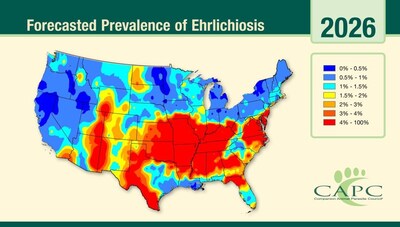
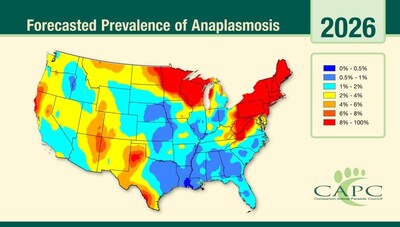
Ehrlichiosis and anaplasmosis risk continues to expand as lone star ticks and brown dog ticks extend their geographic ranges. CAPC's 2026 forecast projects:
- Sustained high ehrlichiosis risk across the Southeast, Southwest, and south-central United States
- Continued northward expansion of lone star ticks into the Upper Midwest and New England
- Increasing brown dog tick-associated risk in the Southwest and Mountain West
- Parallel rises in anaplasmosis risk in regions experiencing Lyme expansion
Because multiple tick species transmit these pathogens – and brown dog ticks can live indoors – transmission can occur year-round in many areas.
"In 2026, the message is clear: vector-borne disease risk is expanding," said Dr. Prior. "Ticks don't feed 365 days a year, but they do feed 12 months a year. 'Low risk' does not mean 'no risk.' Year-round prevention and annual testing are no longer optional – they're foundational."
A One Health Early Warning System
Beyond protecting pets, CAPC's forecasts serve as a valuable One Health early warning system. When new tick-borne pathogens are detected in dogs, it signals shared and evolving public health risk to these vector-borne pathogens as well – reinforcing why continuous, nationwide surveillance is essential.
"CAPC's forecasts are uniquely credible because they're grounded in exceptionally large, real-world diagnostic data," said Chris Carpenter, DVM, MBA, Executive Director of CAPC. "When canine exposure to tick-borne pathogens rises, it often signals intensifying vector activity around people as well. Protecting the pet is protecting the family. By leveraging these forecasts, veterinarians can anticipate risk rather than react to it."
Year-Round Prevention and Annual Testing Remain Essential
CAPC emphasizes that routine diagnostic testing remains the most reliable way for veterinarians to understand local risk of parasitic diseases. The forecast maps complement testing efforts by showing where prevention is working, where gaps exist and where risk is emerging.
Increasing threats in both historically endemic and newly emerging regions underscore the importance of administering parasite preventatives year-round. Consistent, year-round use of products that repel and/or kill ticks and mosquitoes before pathogen transmission occurs remains the cornerstone of prevention.
"The most important takeaway for veterinarians in 2026 is this: Stay proactive," added Dr. Reif. "Test annually, recommend consistent year-round prevention, and use local surveillance data to guide your parasite control programs."
Free Local Forecast Tools
In addition to the annual forecast, CAPC provides:
- 30-Day Parasite Forecast Maps at www.PetDiseaseAlerts.org offer monthly county-level projections that allow veterinarians and pet owners to track emerging threats locally
- Daily Flea Forecasts, also available at www.PetDiseaseAlerts.org, display real-time flea activity across the United States based on environmental conditions
Together, these tools help veterinarians and pet owners tailor prevention strategies to local parasite risk and emerging threats.
About the Companion Animal Parasite Council
The Companion Animal Parasite Council (CAPC) is an independent not-for-profit organization comprised of parasitologists, veterinarians, as well as medical, public health and other professionals, who provide information for the optimal control of internal and external parasites that threaten the health of pets and people. Formed in 2002, CAPC works to help veterinary professionals and pet owners develop the best practices in parasite management that protect pets from parasitic infections and reduce the risk of zoonotic disease transmission. Visit: www.capcvet.org
 View original content to download multimedia:https://www.prnewswire.com/news-releases/capc-2026-pet-parasite-forecast-just-released-expanding-vectors-emerging-hotspots-and-a-new-era-of-year-round-risk-302721737.html
SOURCE Companion Animal Parasite Council

